
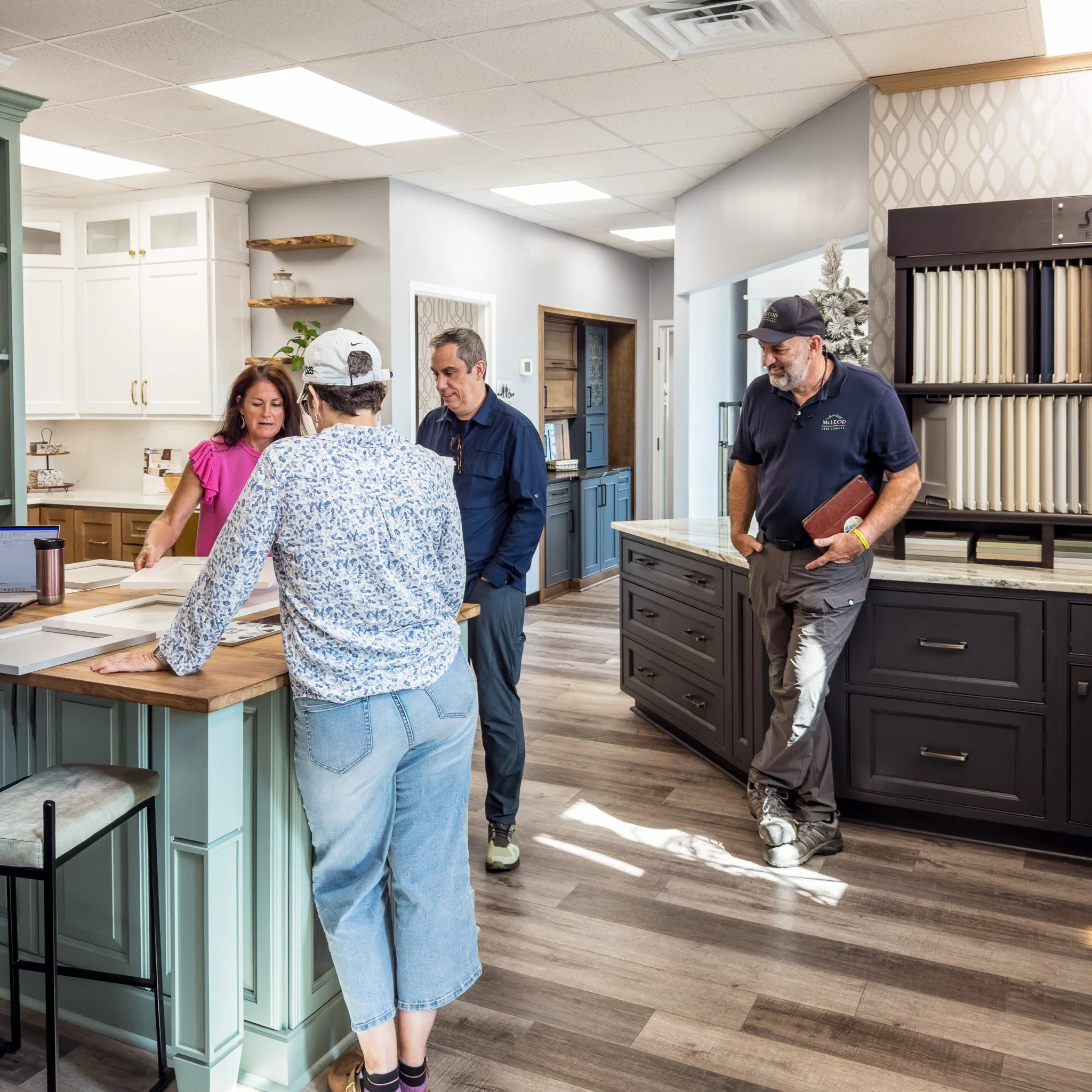
Walk into any kitchen remodel conversation and the cabinets come up fast. They set the style of the room, they hold everything you own, and they are usually the largest single line item in the budget. They are also the part of a kitchen homeowners understand least, because “cabinets” can mean three very different products at three very different price points.
For homeowners across Fuquay-Varina, Holly Springs, Angier, Lillington, Garner, and Willow Spring who are planning a kitchen or bathroom project, this is the breakdown we walk through with clients: what stock, semi-custom, and custom cabinets actually are, how they differ in cost, quality, and timeline, and how to decide which one makes sense for your home.
Stock Cabinets
Stock cabinets are mass-produced in standard sizes and sold with a limited range of styles and finishes. They are built in advance, which makes them the most affordable option and usually the fastest to get.
The advantages: lowest cost, shortest lead time, and plenty of decent options for homeowners on a defined budget.
The tradeoffs: standard sizing means filler strips and gaps where your kitchen’s dimensions don’t match the boxes, a narrower choice of finishes, and few options for specialty storage. Quality varies widely within the stock category, so a stock cabinet from one manufacturer can outperform a semi-custom line from another.
Best for: kitchens with standard dimensions, rental or resale-focused projects, and homeowners who want a clean update at the lowest cabinet cost.
Semi-Custom Cabinets
Semi-custom cabinets start with standard box sizes but offer far more choice. You can select from a wide range of door styles, wood species, finishes, and colors, and you can modify depths, heights, and widths within limits. Add-ons like pull-out trays, spice racks, trash pull-outs, and dividers are typically available.
The advantages: a much better fit to your actual kitchen, more design flexibility, and construction quality that is often a step above stock. For many of our clients this is the sweet spot of cost and customization.
The tradeoffs: higher cost than stock and a longer lead time, since orders are built to your selections. You are still working within the manufacturer’s catalog, so truly unusual dimensions or details may not be possible.
Best for: most full kitchen remodels, particularly when the layout is changing or the kitchen has a few non-standard dimensions.
Custom Cabinets
Custom cabinets are built to your exact specifications: any size, any configuration, any material, any finish. A skilled cabinetmaker builds them around your space and your design, so every inch of the room can be used and every detail can be specified.
The advantages: a perfect fit, unlimited design options, the ability to solve unusual spaces and match existing millwork, and the highest ceiling on quality and craftsmanship.
The tradeoffs: the highest cost and the longest timeline. Custom work also calls for earlier decisions, because details have to be finalized before building begins.
Best for: high-end kitchens, unusual layouts, homes where matching existing woodwork matters, and homeowners who want specific details like inset doors, built-in millwork, or specialty storage.
At McLeod Contracting Group we work with skilled trade partners who build custom cabinetry from scratch, so when a project calls for it, we can bring that level of craftsmanship into your kitchen and manage it alongside the rest of the project.
What Actually Separates Good Cabinets From Poor Ones
Price tier is only part of the story. Two cabinets in the same category can differ a lot in how they are built and how long they last. These are the construction details worth asking about on any quote.
Box material. Plywood boxes generally hold up better than particleboard, especially around the sink and dishwasher, because they tolerate moisture better and hold screws better over time. In North Carolina’s humid climate, that matters. Ask exactly what the boxes and the drawer boxes are made of.
Drawer construction. Dovetail joints and solid drawer boxes outlast stapled or glued drawers. Soft-close hardware and full-extension slides are worth having on the drawers you use every day.
Door and face construction. Solid wood or well-made veneer doors hold their finish and shape better than thin, low-grade alternatives.
Finish quality. A durable, even finish resists wear around handles and the sink and cleans more easily over the years.
Installation. Even the best cabinets look poor if they are installed out of level or plumb. Experienced installers, careful layout, and attention to scribing and filler details make a visible difference, and that holds at every price tier.
Timing: Why Cabinets Drive the Schedule
Cabinets are usually the longest-lead item in a kitchen project. Stock is typically the quickest, semi-custom takes longer, and custom takes the longest because it is built after your selections are final. Exact timing varies by manufacturer and builder, and it is one of the things we confirm during pre-construction and design.
That is why we lock in cabinet selections before the construction contract is signed. Cabinet orders can be placed right away, and other trades are scheduled around the delivery date instead of the project stalling while everyone waits. Changing cabinet selections midstream is one of the most common causes of delay on kitchen remodels, which we covered in our blog on why renovation projects go over budget.
Before You Replace Them: The Kitchen Refresh Option
Replacing cabinets is the single biggest cost in a kitchen remodel, and many homeowners don’t need to do it. If your layout works and the cabinet boxes are solid, the McLeod Kitchen Refresh is often the smarter path. Our trade partners offer three options.
Repainting gives sound cabinets a new color and a professional finish.
Refinishing restores the existing finish to a like-new condition.
Resurfacing replaces the door and drawer fronts while keeping the existing boxes, a middle ground between painting and full replacement.
Paired with new countertops, a backsplash, hardware, a sink and faucet, and updated lighting, a refresh can transform a dated kitchen for a fraction of the cost of a full remodel. If your cabinet boxes are damaged, water-affected, or poorly laid out, replacement is the right call. If they are structurally sound, it’s worth a conversation before you spend the money.
How to Choose
A few questions usually point to the right answer.
Is the layout changing? If you are moving walls, relocating appliances, or reconfiguring the kitchen, new cabinets are almost always part of the plan, and semi-custom or custom gives you the flexibility to get the layout right.
Are the existing boxes in good shape? If so, consider a refresh before replacing them.
What is your budget range? Cabinets typically consume a large share of a kitchen budget. Our kitchen projects start at $35,000 for a Refresh, $60,000 for Gold, and $95,000 for Signature, and the cabinet decision is one of the biggest factors in where a project lands within those tiers. If you’d like help thinking through the full budget, start with our guides on what a renovation actually costs and how to finance one, including financing through our HFS Financial partnership.
How long do you plan to stay? The longer you plan to live in the home, the more a higher-quality cabinet is worth.
How much does fit matter? In a kitchen with unusual dimensions or a tight footprint, the exact fit of semi-custom or custom often justifies the cost.
There is no single right answer. The right cabinet is the one that fits your kitchen, your timeline, and your budget, and a good contractor should help you weigh those honestly instead of steering you to the most expensive option.
If you’re planning a kitchen or bathroom remodel in Fuquay-Varina, Holly Springs, Angier, Lillington, Garner, Willow Spring, or anywhere across Wake, Harnett, or Johnston Counties, we would love to look at your space and give you an honest recommendation on cabinets, whether that means replacing, refreshing, or keeping what you have.
