
What Does a Home Renovation Actually Cost in Fuquay-Varina NC? A Honest Guide for Homeowners
One of the most consistent patterns we see at McLeod Contracting Group — across discovery calls, site visits, and first conversations with homeowners across Fuquay-Varina, Holly Springs, Angier, Lillington, Garner, and Willow Spring — is a significant gap between what homeowners expect a renovation to cost and what it actually costs in our market.
A homeowner who has seen a kitchen transformation on a home improvement show, scrolled through a renovation on Instagram, or gotten a number from a neighbor a decade ago frequently arrives at the first conversation with a budget that is a fraction of what their project actually requires. The gap isn't always their fault — renovation cost information online is often national, often outdated, and almost never accounts for the specific market conditions, material costs, labor rates, and permit requirements of a specific area.
The result is a frustrating experience for everyone involved. The homeowner feels blindsided. The contractor feels like the bearer of bad news. And a project that could have been well-planned and well-executed stalls before it even starts because the budget conversation was never had honestly — or never had at all.
We believe the right approach is transparency upfront. So this week we're doing something most contractors won't — publishing honest, realistic investment ranges for the projects we complete most often across Wake, Harnett, and Johnston Counties, along with the resources that can help you research further on your own.
Why Renovation Costs Are Higher Than Most Homeowners Expect
Before getting into specific numbers, it helps to understand why renovation costs in the Fuquay-Varina area — and across North Carolina broadly — are where they are. This isn't about contractors padding margins. It's about the real costs behind a professionally managed, properly permitted renovation.
Licensed trade work costs money. Plumbers, electricians, and HVAC technicians in Wake County and Harnett County are licensed professionals whose rates reflect their training, their licensing requirements, their insurance obligations, and the demand for their skills in a growing market. When a bathroom renovation requires licensed plumbing rough-in, licensed electrical work, and proper inspections — all of which are legally required in North Carolina — that trade labor is a real cost that does not appear in the "budget bathroom remodel" content homeowners find online.
Materials cost more than they used to. The cost of cabinetry, tile, countertops, flooring, fixtures, and lumber has increased significantly over the past several years. A kitchen remodel that cost a certain amount five years ago costs meaningfully more today — not because contractors are charging more, but because the materials themselves cost more.
Permits and inspections are real costs. Building permits in Wake County, Harnett County, and Johnston County cost money — and the time required to submit applications, coordinate inspections, and manage the permit process through approval is a real project management cost that is built into any professional estimate.
General contractor overhead exists for a reason. A licensed general contractor who carries proper insurance, employs or contracts experienced project management, uses professional project management systems, and backs their work with a warranty has overhead that reflects those commitments. That overhead is what protects the homeowner — and it is part of every professional estimate.
McLeod Contracting Group Investment Ranges
The following starting-at prices reflect what professionally managed, properly permitted renovation projects cost at McLeod Contracting Group across our service area. These are not worst-case numbers — they are realistic starting points based on our actual project experience in the Wake, Harnett, and Johnston County market.
Every project is quoted individually based on the specific scope, the existing conditions of your home, your material selections, and the extent of licensed trade work required. These ranges are intended to give you a realistic picture before the first conversation — not to replace the detailed proposal that follows a proper site visit and pre-construction process.
We offer three tiers across most project categories — Refresh, Gold, and Signature — reflecting the scope and finish level that best matches each homeowner's goals and investment.
Kitchen
Refresh starting at $35,000 | Gold starting at $60,000 | Signature starting at $95,000
A Kitchen Refresh at the starting range includes targeted upgrades — new countertops, backsplash, cabinet repainting or refinishing, hardware, sink, faucet, and lighting — that transform a dated kitchen without a full gut renovation. Gold encompasses a full kitchen remodel with semi-custom cabinetry, quality countertops, tile backsplash, and updated appliances. Signature reflects a high-end full remodel with custom cabinetry, premium countertop materials, professional-grade appliances, and comprehensive design coordination.
Powder Room
Refresh starting at $7,000 | Gold starting at $12,000 | Signature starting at $20,000
Hall / Guest Bathroom
Refresh starting at $15,000 | Gold starting at $25,000 | Signature starting at $40,000
Primary / Master Bathroom
Refresh starting at $30,000 | Gold starting at $60,000 | Signature starting at $90,000
A primary bathroom at the Refresh level addresses cosmetic updates — new vanity, fixtures, paint, lighting, and minor tile work — within the existing layout. Gold encompasses a full renovation including walk-in shower, new tile, double vanity, updated electrical and plumbing, and quality fixture selections. Signature reflects a full primary bathroom transformation with premium tile, thermostatic shower system, freestanding tub, heated floors, and high-end finishes throughout.
Home Additions
Starting at $100,000 (approximately $275–$350 per square foot) | Gold starting at $150,000 | Signature starting at $250,000
Home addition pricing is driven heavily by square footage, structural complexity, foundation type, and the extent of plumbing and electrical rough-in required. The per-square-foot range of $275–$350 is a realistic starting point for well-finished addition work in our market.
Attic Build-Outs
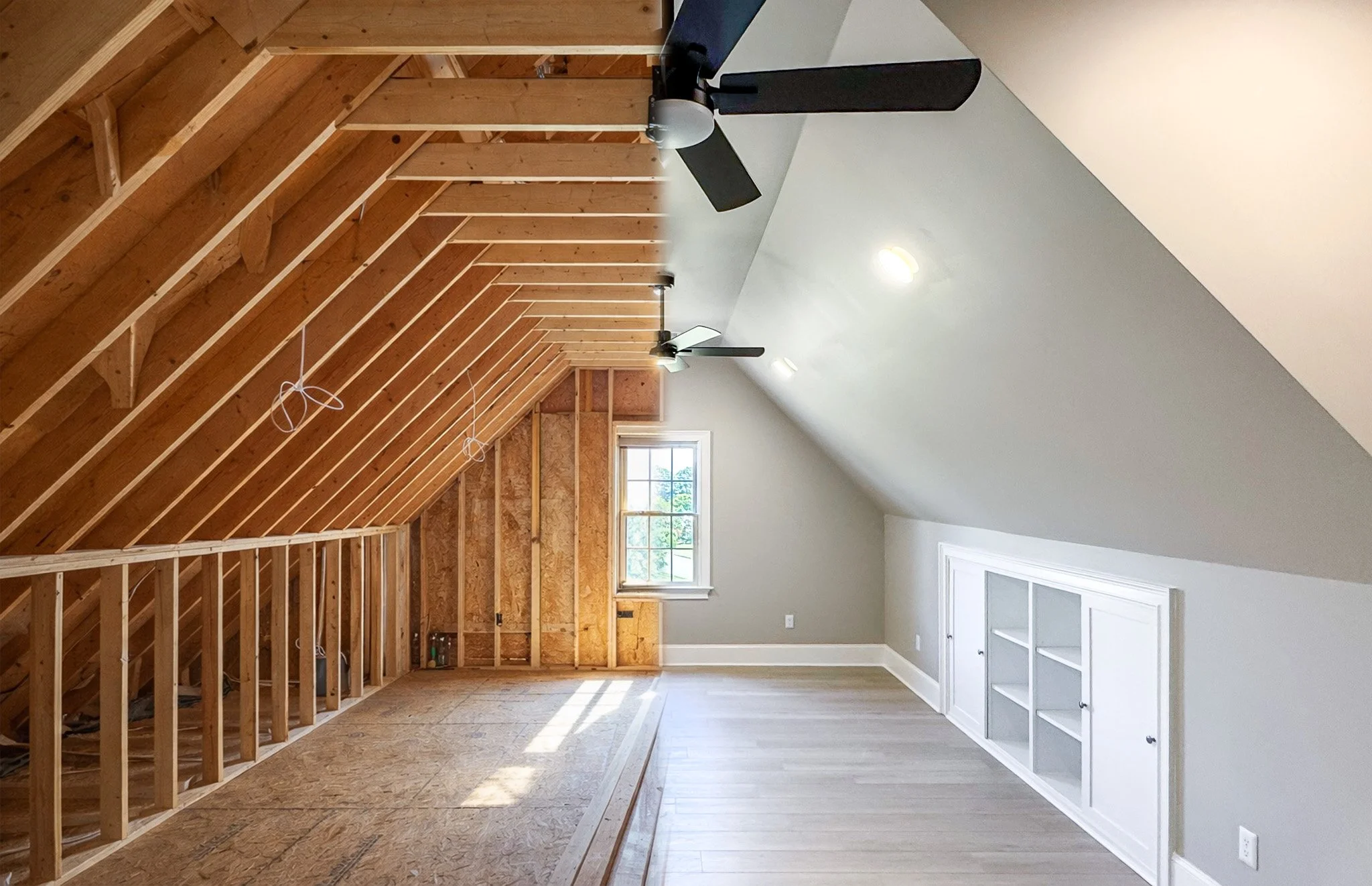
Refresh starting at $40,000 | Gold starting at $70,000 | Signature starting at $125,000
Decks & Outdoor Living
Refresh starting at $20,000 | Gold starting at $40,000 | Signature starting at $65,000
Crawl Space & Structural
Refresh starting at $10,000 | Gold starting at $20,000 | Signature starting at $35,000
What the Raleigh Market Data Says
For homeowners who want to validate these ranges against independent market data, the 2025 Cost vs. Value Report — produced annually by Zonda Media and available at costvsvalue.com — provides Raleigh-specific project cost benchmarks that are among the most reliable independent renovation cost references available.
A few data points from the 2025 Raleigh report that are worth knowing as you plan your renovation:
According to the 2025 Cost vs. Value Report, a midrange minor kitchen remodel in the Raleigh market — defined as updating an existing kitchen by replacing cabinet fronts, adding new hardware, replacing countertops, and installing new flooring — carries a job cost of approximately $27,400. A midrange major kitchen remodel — new semi-custom cabinetry, new countertops, new appliances, and new flooring in an existing layout — runs approximately $80,100. An upscale major kitchen remodel with custom cabinetry, stone countertops, and premium appliances runs approximately $159,200 in the Raleigh market.
For bathrooms, the report shows a midrange bathroom remodel at approximately $25,800 in the Raleigh area. An upscale bathroom remodel — expanded footprint, large tile floor with in-floor heating, frameless glass shower, freestanding soaker tub, and custom vanity — runs approximately $80,600.
A midrange primary suite addition carries a Raleigh market job cost of approximately $157,800. An upscale primary suite addition runs approximately $323,200.
For outdoor living, a composite deck addition runs approximately $23,500 in the Raleigh market. A wood deck addition runs approximately $16,400.
©2025 Zonda Media, a Delaware corporation. Complete data from the 2025 Cost vs. Value Report can be downloaded free at www.costvsvalue.com.
These numbers align closely with what we see in the Fuquay-Varina and Wake County market — and they reinforce the same core message: quality renovation work is a significant investment. Budgets of $10,000–$15,000 for a full kitchen or bathroom renovation are not realistic in our market — and a contractor who tells you otherwise is either leaving things out of the scope or planning to add them back in through change orders once work has begun.
Why "Starting At" Matters — and What Drives Costs Higher
Every starting-at number published above is exactly that — a starting point. The final cost of any renovation project is determined by a combination of factors that we assess during the site visit and formalize during the pre-construction and design phase. Here are the most common factors that move a project above the starting range:
Material selections. The difference between a Refresh-level project and a Signature-level project is largely driven by materials. Builder-grade tile vs. large-format porcelain. Stock countertops vs. custom stone. Standard fixtures vs. designer plumbing. Every selection the homeowner makes contributes to the final cost — which is why we recommend locking in selections during the pre-construction phase rather than leaving them as allowances that get revisited mid-project.
Existing conditions. What is behind the walls, beneath the floors, and under the house matters. Older homes across the Fuquay-Varina area sometimes have outdated plumbing, undersized electrical panels, or structural conditions that affect the cost of a renovation that looks straightforward on the surface. We identify these during the site visit wherever possible — and document any unexpected conditions discovered during construction immediately through written change orders that require the homeowner's approval before additional work proceeds.
Scope additions. The homeowner who starts with a bathroom refresh and adds a heated floor, a second vanity, and a niche in the shower during the design phase is making the right decisions — but each addition moves the final cost above the starting number. We welcome those conversations. We just have them before construction begins rather than after.
Layout changes. Moving plumbing, relocating electrical, removing walls, or expanding a footprint all add meaningful cost to a renovation scope. A cosmetic refresh that stays within the existing layout will almost always land at the lower end of the range. A project that reconfigures the layout will not.
How to Use This Information
The goal of publishing these ranges is not to discourage homeowners from pursuing the renovation they want. It is to help you enter the planning process — and the contractor conversation — with realistic expectations that allow for productive, honest conversations from the very beginning.
Here is how we recommend using this information:
Start by identifying the tier that aligns with your goals and your budget. If your kitchen renovation vision aligns with a Signature-level scope but your current budget is in the Refresh range, that is a useful conversation to have early — either to adjust the scope, adjust the timeline, or adjust the expectations. All of those are better outcomes than signing a contract based on an unrealistic number and discovering the gap mid-project.
Use the Cost vs. Value report at costvsvalue.com and the JLC Online resource at jlconline.com to validate what you are hearing from contractors in your market. If a contractor's estimate is significantly below what the independent data suggests, ask specifically what is included and what is not.
And when you are ready to have a real conversation about what your specific project will cost — based on your specific home, your specific goals, and your specific material selections — that is exactly what our site visit and pre-construction process is designed to do.
We give you a ballpark range at the end of the initial site visit — based on what we saw, what you told us, and what similar projects have cost in our market — and we refine that into a real, detailed proposal during the pre-construction and design phase. No surprises. No lowball numbers designed to win the job. Just honest guidance from a contractor who believes an informed homeowner is the best kind of client.
If you are planning a renovation project in Fuquay-Varina, Holly Springs, Angier, Lillington, Garner, Willow Spring, or anywhere across Wake, Harnett, or Johnston Counties and want to start with an honest conversation about what your project will actually cost — we would love to hear from you.
INTERNAL LINKS:
"Why Some Renovation Projects Go Over Budget" — Week 5 blog
"Where to Save vs Where to Spend on a Home Renovation" — Week 6 blog
"How to Compare Contractor Estimates the Right Way" — Week 3 blog
"What a Good Contractor Should Include in an Estimate" — Week 4 blog
"Kitchen Remodeling & The McLeod Kitchen Refresh" — recent blog
"Bathroom Remodeling in Fuquay-Varina NC" — recent blog
"Our Design & Construction Process" — Week 10 blog
